Showing posts with label culture. Show all posts

Wednesday, May 15, 2019

Discipline and containment


6pm, the sunset starts. Meanwhile, families gather around the table, ready to enjoy a copious dinner after a whole day without eating or drinking anything. This is iftar, the meal when people break the fast during Ramadan, the holy month in Islam, which started on May 6th. This is the first time I am in a Muslim country during this event, which affects everyone’s life, regardless each one’s religion.
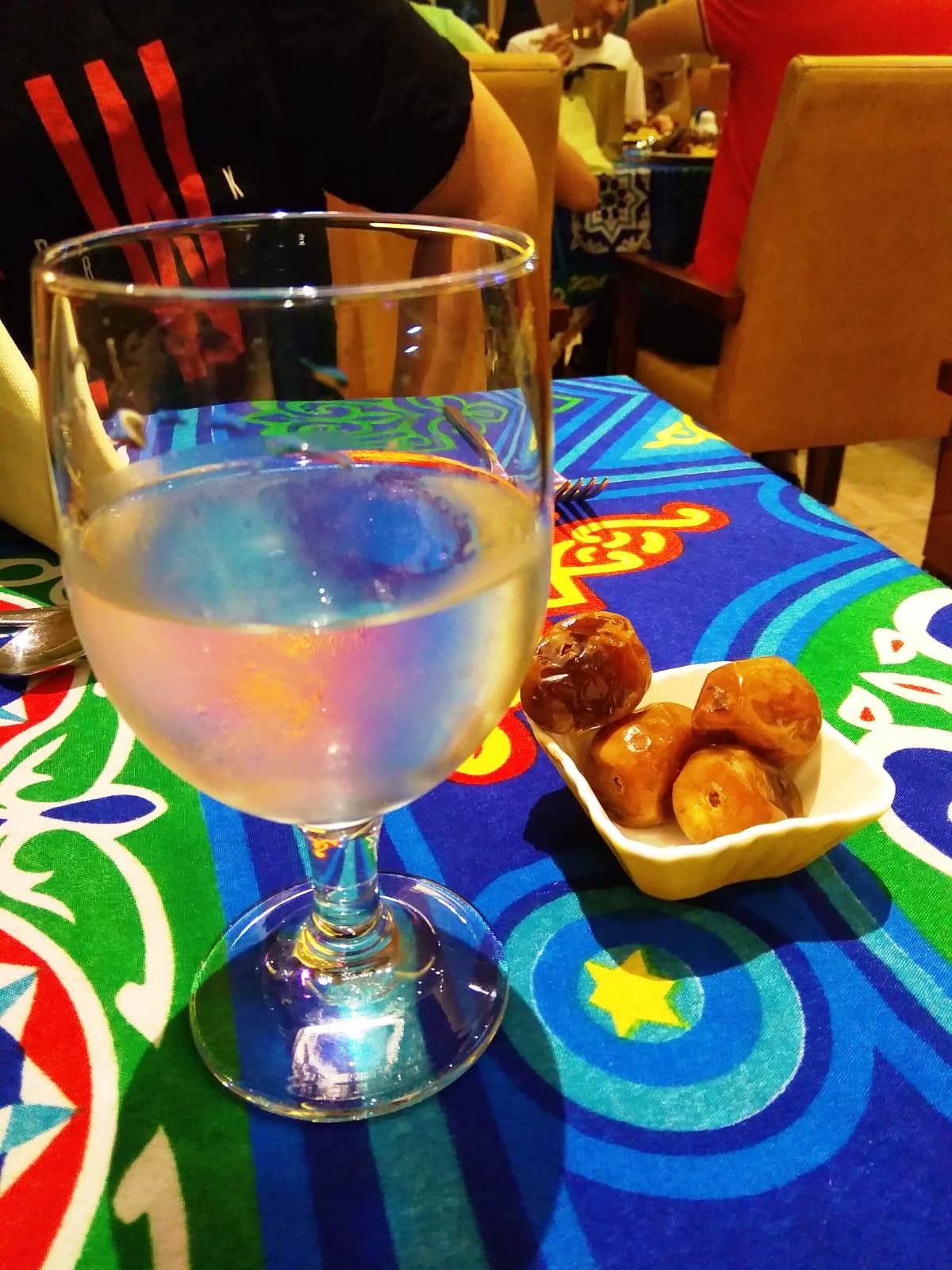


Fasting or sawn is the most known characteristic in this period and it is one of the five pillars of Islam. It starts at dawn, right after the suhur, a strong breakfast to resist the rest of the day, and it ends with the sunset. During this time, eating, drinking (even water) and having sexual relationships are forbidden for the Muslims. Elderly people with health problems, pregnant women and children younger than 12 years old are exempt from this practice. Besides fasting, the Muslims also celebrate these days of sacrifice and spirituality, performing good deeds, helping the most needy people and giving alms, action known as zakat, another pillar of the Islamic religion, which happens more often these days.
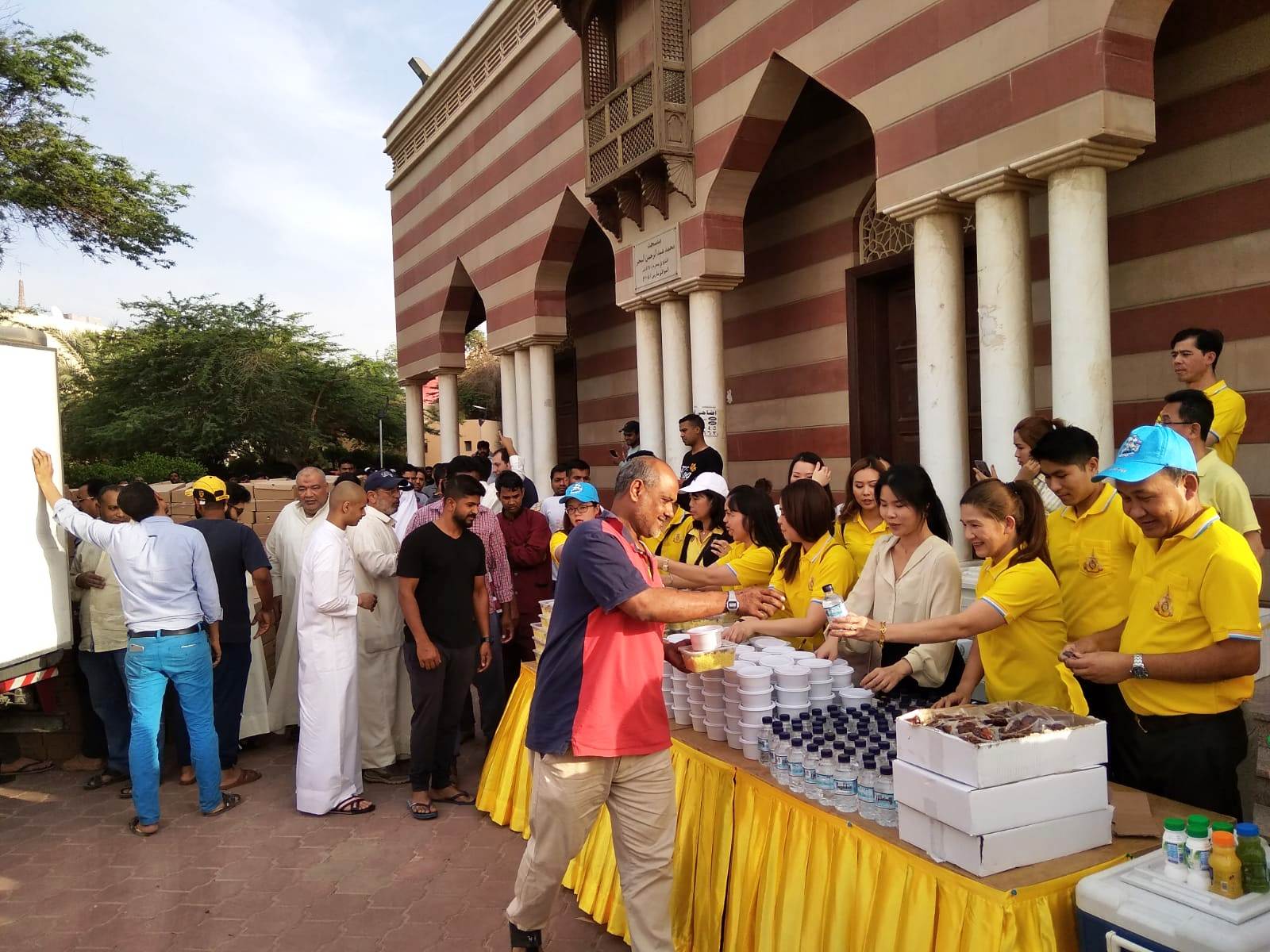
 
Donation of food organized by Thai Embassy
About my daily life, in this month we have a reduced work schedule and less students in the classrooms. The shops also modify their opening time these days and some of them close completely during the whole month. The obligation to stop eating and drinking during daytime is also applied to Non-Muslim people. Any person, regardless his/her religion, who can be seen breaking the fast or smoking in the streets or any other public place can be penalized with a 100 KD (almost 300 euros) fine and one month in jail. mes de cárcel.

Many shops and supermarkets offer discounts during this month
But, beyond the restrictions related to Ramadan, I would like to highlight that it is also a good occasion to celebrate meetings with relatives and friends, where happiness, generosity and solidarity truly reign. This happens almost everyday after sunset. In part, it can be perceived as something equivalent to our Christmas events in our Western countries. Certainly, it is worthy to attend some of these celebrations if you have the chance and sharing the moment.


¡Ramadan Kareem for everyone!

Thursday, November 8, 2018

Finding the right tune


Among the new things at the school where I work this year compared to the previous ones, I have to highlight the fact of not including the subject of Music in the school curriculum. The music, logically, is present at the life of every student, teacher and other staff member, but here they prefer to keep it for private life and leisure time. It is perceived as a entertainment and distraction, rather than a learning source and interaction with the environment, as it should be inside my mindset. This matches with the Islamic values at my school, very conservative as I could realize in these two first months.


The topic of the music provokes some controversy in the Islamic world. While some orthodox approaches see it as a something as offensive as drinking alcohol, other persons understand it as admissible and even as a element to be included in religious rituals, like the dervishes in Turkey. At the end, as it happens with other cultural characteristics such as using the veil, everything depends on the interpretation of each person has of the Koranic scriptures. I would like that some Muslim person correct me if I am wrong, but I couldn’t find any concrete verse prohibiting music, although it is suggested that it can be connected to sinful acts.


Sufi musician in the Muslim quarter of Nizalmuddin in Delhi (India)

Besides restrictions and prohibitions, actually in Kuwait the music is present in many events. Only in the last month I could attend a musical Broadway style, a performance of Korean dance groups, both traditional and break dance, and a concert of traditional Andean music. It is true that most of the performers are foreigners, resident or visitors, but there are also some local groups trying gain some recognition.


I don’t think that someday we will enjoy Music lessons at my school, but I guess it could be possible to arrange a short musical performance for some special event, such as the international week, for example. I have to check it with caution because you never know what might happen. Living inside a different culture is good for learning to perceive things from different points of view and mindsets. Many situations that we can see completely normal in our countries, here it could be a scandal, and vice versa. The most important, as always, is respect and tolerance in order to adapt and understand that there are multiple ways to perceive the World.


Tuesday, September 11, 2018

In the name of the father (and the grandfather's, the great-grandfather's...)


In these first days at the school, one my usual tasks is to manage the personal files for each student, arranging those who just joined this year. After checking the names and surnames of the students before entering their files in the archive, I could noticed, in certain cases, the remarkable length of some of them. That leaded me to investigate a bit more about the interesting world of the Arabic onomastics.

The 99 names of Alah, in the dome of the Grand Mosque of Kuwait
Abdullah Ahmed Mohammed Faisal Ali Abdul Aziz Al-Mubarak. This is a fictitious example of what any name could be in the Arabic countries. Nowadays, it is true that the way to name a person became more simple, using just a first name and a family name (called nisbah), but traditionally the name of a person also includes the name of the father, the grandfather’s and, sometimes, even the great-grandfather’s and other previous generations. Technically, each of these names should be followed of the particles ibn (“son”) or bint (“daughter”), but in most of the Arabic countries they are omitted.

Monument of the Cordoban poet and philosopher, Ibn Hazm (source: Wikipedia)


Sometimes, there is a word preceding the name, called kunya, expressing respect and honor towards other person. Some of the most common are Abu (“father”), Umm (“mother”) or Abdul (“servant”). One of the most frequent mistakes we commit in Western countries is separating the kunya from its related name, considering it as a name apart. For example, if we call someone just Abu, it would be like if we call him “someone’s father”, it wouldn’t make sense without the posterior name.

Kareem Abdul (servant of) Jabbar (source: Pinterest)


This way of naming could explain why, since I am here in Kuwait, every time that someone submits an official document with my name, most of the times they use just Francisco and my second surname (in Spain we have two surnames), assuming that it is my family name. My second name (I have a composed name) and my first surname usually are omitted since, possibly, they can be considered as my father’s and my grandfather’s name. Do you have any experience like that with your name being in an Arabic speaker country?

See you next time!

Tuesday, April 3, 2018

The "mega museum"


Last Thursday I had the chance to visit for the first time, together with my girlfriend and friends, the Sheikh Abdullah Al-Salem cultural center, inaugurated just few weeks ago. This complex of 13 hectares, which includes six themed buildings and a theater, is one of the biggest of the world related to culture and sciences, and it already became of the main landmarks in Kuwait, which continues moving forward in its modernization process.

Each building of the complex is dedicated to one field of knowledge. Just at the beginning, on the right hand, you can find the Space Museum. In front, on the right side, the Arabic Islamic Science museum, which also includes the Fine Arts Centre. Continuing walking towards the end, after passing the theatre on the right hand, you can see the two buildings of the Science and Technology Museum and, at the end, other two structures hosting the Natural History Museum. Each one of these buildings is divided in themed halls with a very interactive and innovative format.


One of the best part I saw was the Natural History Museum. I really enjoyed all the part of the history of life in the Earth, since the first multicellular organisms until now, through the age of the dinosaurs and other extinguished species. It reminded me my hobby when I was a child, when I felt interest about books of animals and I had a nice time reviewing knowledge that I still have in some part of my brain. Other interesting area is the one about ecosystems, especially the part of the rainforest, amazing.


The Science and Technology Museum is divided in two buildings. We only visited the human body section. Here you can review the physiologic functions and the parts in our anatomy, including a corner related to psychological processes, where you can test your short memory and check your personality profile doing a short test, among other things.

The whole experience was great but everyone was exhausted at the end. In two hours and a half, we just had time to see a third part of the complex, so we will need to repeat. In this link you can find all the information about this place, including prices and timetables: https://www.ascckw.com/
I recommend you to go now these days, when weather is still no too hot, it is really worthy.